
Your Gelcoat Is a Sacrificial Layer -- Treat It Like One
Gelcoat is not paint. It is a pigmented polyester or vinyl ester resin that was sprayed into the mold before your hull was laid up. That smooth, glossy surface you admire is doing real structural work: shielding the underlying fiberglass laminate from water intrusion, UV radiation, and chemical exposure. When gelcoat degrades, the entire composite structure is at risk. Waxing is not cosmetic vanity. It is the single most effective maintenance step for preserving this protective barrier season after season.
I track the condition of every exterior surface on my Azimut with the same rigor I once applied to research protocols. After testing dozens of waxing products and schedules over the past eight years, the patterns are unambiguous. Boats that receive consistent, properly applied wax protection maintain their gelcoat integrity far longer than those given sporadic attention. This gelcoat waxing guide lays out exactly how to do it right.
Key takeaways:
- Wax gelcoat every 2-4 months depending on conditions (use the water bead test to check)
- Surface prep determines most of the outcome — wash, destain, dry fully before waxing
- Apply thin, even coats in 2×2 ft sections; two coats outperform one thick coat
- Carnauba wax lasts 2-3 months; synthetic sealants 3-6 months; poly-coatings a full season
- Never use dish soap, bleach, acetone, or high-alkaline cleaners on gelcoat
Understanding Gelcoat Properties
Fresh gelcoat has a smooth, non-porous surface with natural UV resistance. That resistance does not last indefinitely. As BoatUS Foundation's fiberglass care resources confirm, unprotected gelcoat exposed to UV radiation undergoes photochemical oxidation — the resin chains break down, the surface becomes chalky, and the once-glossy finish turns flat and rough. Once gelcoat becomes porous from degradation, it absorbs stains, retains moisture, and accelerates further deterioration.
Marine detailing professionals describe gelcoat as having a finite UV budget. Every hour of unprotected sun exposure spends a portion of that budget. Wax and sealant act as a sacrificial UV absorber, taking the damage instead of the gelcoat beneath.
The other critical vulnerability is water penetration. Degraded gelcoat allows moisture to reach the fiberglass laminate, where it can cause blistering -- a costly repair that involves grinding away affected areas and relaying the surface. Maintaining a hydrophobic wax barrier prevents this chain of events from starting. For a deeper look at what happens when oxidation takes hold, see our oxidation removal complete guide.
How Often Should You Wax Boat Gelcoat?
The standard recommendation from West Marine's gelcoat care resources is to wax every 3-4 months, or roughly once per season for temperate-climate boaters. In saltwater environments or regions with intense year-round sun exposure, marine detailing professionals recommend shortening that interval to every 2-3 months.
Rather than relying on the calendar alone, use the water bead test. Pour a cup of water on the hull above the waterline. Protected gelcoat will cause the water to bead into tight droplets. When water begins to sheet and spread flat, the wax layer has worn through.
Other signs that waxing is overdue:
- Chalky residue when you run a finger across the surface
- Visible color fading compared to protected areas under rub rails or hardware
- Stains that resist normal pH-neutral washing
- Rough texture where the surface was previously smooth
If you see moderate to heavy chalking or oxidation, waxing alone will not restore the surface. You will need to compound or polish first to remove the damaged layer before applying wax. Our guide to removing oxidation from boat gelcoat covers that process in detail.
Surface Preparation
Any marine detailing professional will tell you that surface prep determines most of the outcome when waxing a boat. Wax applied to a dirty or contaminated surface traps debris underneath and fails to bond evenly.
Wash Thoroughly
Start with a full wash using a pH-neutral marine boat wash. August Race Boat Wash Pro at standard dilution handles this well — it cleans effectively without stripping any remaining wax protection. Avoid dish soap -- it is designed to cut grease and will strip every trace of existing wax and any natural oils from the gelcoat surface.
Work from top to bottom with a soft wash mitt, rinsing each section before moving on. Pay extra attention to areas around hardware, scuppers, and rub rails where grime accumulates.
Address Stains Before Waxing
Any stains present before waxing will be sealed beneath the wax layer. Waterline scum, rust streaks, and tannin stains must be removed first. A marine-grade gelcoat destainer handles most common discolorations without damaging the surface. Apply it to stained areas, allow it to work, then rinse clean.
Dry Completely
Water trapped under wax creates hazy spots and prevents proper adhesion. Dry the entire surface with clean microfiber towels or a forced-air blower. Marine detailing professionals recommend allowing at least 30 minutes of air-drying time after toweling off before starting wax application.
Mask Off Non-Gelcoat Surfaces
Use masking tape to protect rubber trim, non-skid surfaces, vinyl graphics, and any textured areas where wax residue would be difficult to remove. This step saves significant cleanup time.
Step-by-Step Wax Application
Tools needed: orbital polisher or foam applicator pad, clean microfiber towels (at least 4-6), marine wax or UV sealant, masking tape
Estimated time: 2-4 hours for a 25-foot boat
Step 1: Apply Wax in Thin, Even Coats
Load a small amount of wax onto your applicator pad or polisher bonnet. Less is more -- thick coats do not provide better protection and are harder to buff. Work in sections of roughly 2 feet by 2 feet, applying the wax in overlapping circular motions.
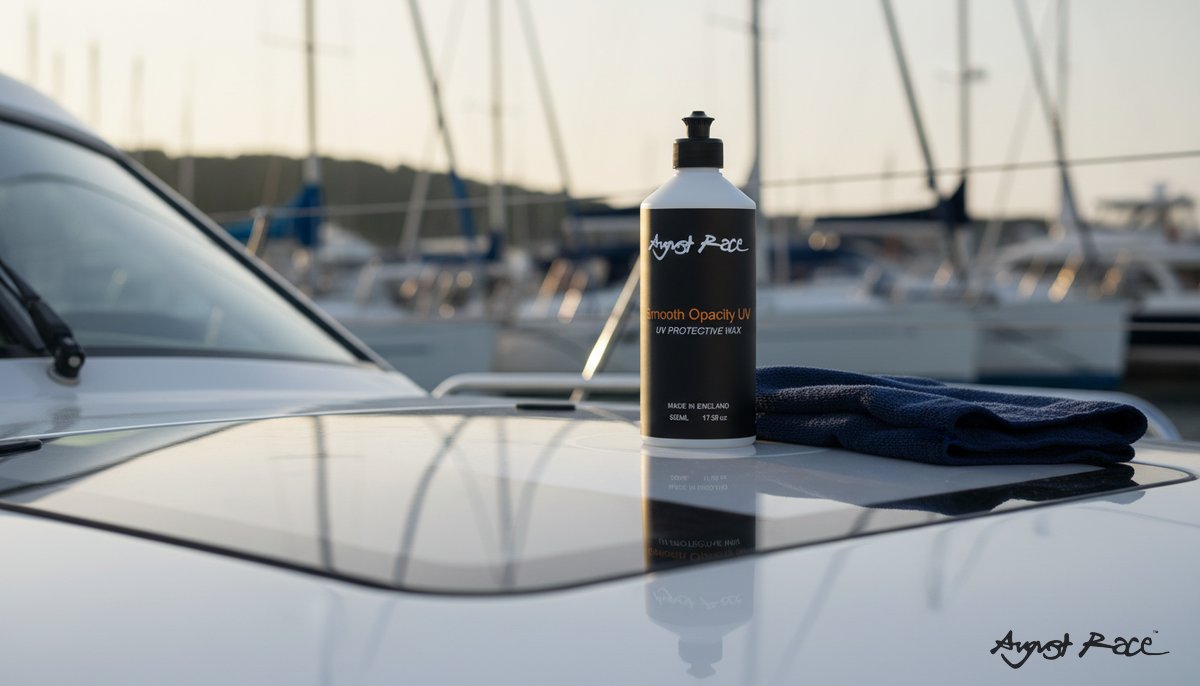
August Race Smooth Opacity UV applies cleanly with either a foam pad or an orbital polisher. Its UV-protective formula creates a hydrophobic barrier while enhancing surface gloss. Apply it neat -- no dilution needed.
If using a dual-action orbital polisher, keep the speed low (setting 2-3 on most machines) during application. The goal is even distribution, not aggressive polishing.
Step 2: Allow the Wax to Haze
After applying a section, allow the wax to dry to a light haze. This typically takes 5-15 minutes depending on temperature and humidity. The surface will develop a slightly cloudy appearance when ready.
Do not let wax sit too long in direct sun or high heat. Baked-on wax becomes extremely difficult to remove and can leave permanent streaks. This is why working in shade -- or at minimum during cooler morning or evening hours -- matters so much.
Step 3: Buff to a High Gloss
Using a clean, dry microfiber towel, buff the hazed section with light to moderate pressure. Turn the towel frequently to expose a fresh surface and avoid dragging removed wax residue back across the finish.
For large hulls, a polisher with a clean microfiber bonnet speeds this step considerably. Keep the machine moving to avoid heat buildup in any single spot -- gelcoat scratches more easily when heated.
Step 4: Apply a Second Coat
A single coat provides baseline protection, but a second coat fills any thin spots and extends the protection window by several weeks. Allow the first coat to cure for at least 20-30 minutes before applying the second layer using the same technique.
Step 5: Inspect and Detail
After the final buff, inspect the surface from multiple angles under natural light. Look for missed spots, streaks, or areas where the wax has built up unevenly around hardware or edges. Clean up any wax residue on trim or non-skid areas with a damp microfiber cloth.
Which Type of Marine Wax Should You Use?
Marine waxes fall into three categories, and the right choice depends on your usage pattern and maintenance schedule.
Carnauba wax produces the warmest, deepest gloss but offers the shortest protection window -- typically 2-3 months in moderate conditions, less in tropical sun. It is the traditional choice and easy to apply by hand.
Synthetic wax and sealant uses polymer technology to bond more durably to gelcoat, lasting 3-6 months. August Race Smooth Opacity UV falls into this category, combining UV-blocking chemistry with a hydrophobic surface barrier that causes water to bead and sheet off.
Poly-coatings and ceramic sealants represent the longest-lasting option. August Race GRP Sealer UV is a UV-protective poly-coating that bonds to fiberglass and creates a hi-gloss, hydrophobic finish. Its biodegradable formula provides hard protection that can last through an entire season on boats that see moderate use. For owners who want maximum duration between applications, this is the logical choice.
Some owners layer products: a poly-coating as the base layer for durability, topped with a wax for enhanced gloss and an additional UV buffer. This approach works well but adds application time. For a broader look at UV shielding across all boat surfaces, see our UV protection marine guide.
Maintenance Schedule
Consistency matters more than perfection. A boat waxed every three months with a basic product will hold up better than one given a single meticulous application per year.
| Condition | Wax Interval | Notes |
|---|---|---|
| Freshwater, covered storage | Every 4-6 months | Lowest UV exposure, longest intervals |
| Freshwater, outdoor storage | Every 3-4 months | UV accumulation is the primary concern |
| Saltwater, regular use | Every 2-3 months | Salt spray accelerates wax breakdown |
| Saltwater, full sun, trailered | Every 2 months | Highest exposure; water bead test monthly |
Between full wax applications, extend protection with a rinse-down after every outing. Fresh water removes salt crystals that abrade the wax film. A quick spray-on wax detailer after rinsing adds a thin supplementary layer without the full application process.
What Products Should You Never Use on Gelcoat?
Gelcoat is resilient but not indestructible. These common mistakes accelerate damage rather than prevent it:
- Acetone or strong solvents strip all wax protection instantly and can soften the gelcoat surface with repeated exposure. Use them only for repair work, not routine surface prep.
- Bleach-based cleaners cause chemical burns on gelcoat and destroy wax protection instantly.
- Abrasive household cleaners -- scouring powders, bathroom cleaners -- scratch the surface and create entry points for moisture.
- High-alkaline degreasers strip wax and can etch gelcoat if left in contact too long.
- Dish soap is engineered to cut through wax and grease. One wash with dish soap undoes your waxing work.
- Waxing in direct sun or extreme heat causes the product to bake onto the surface rather than bonding properly, and the heat itself makes gelcoat more susceptible to scratching.
Stick to pH-neutral marine wash for routine cleaning and marine-specific wax products for protection. The material care guides hub has detailed compatibility information for every common boat surface.
Expert Tips
The two-bucket wash method prevents cross-contamination during pre-wax cleaning. One bucket holds soapy wash water, the other holds clean rinse water. Dip your mitt in the wash bucket, clean a section, then rinse the mitt in the rinse bucket before reloading with soap. This keeps grit out of your wash solution and off the gelcoat.
Clay bar treatment before waxing removes bonded contaminants that washing alone cannot lift. Run your hand across the washed gelcoat. If it feels rough or gritty despite being clean, a marine clay bar will pull out embedded particles and leave the surface glass-smooth for wax adhesion.
Work stern to bow on sailboats and bow to stern on powerboats, following the direction of water flow. This ensures you are always working on a dry section and that drips from your current section do not contaminate areas you have already completed.
Label your microfiber towels. Dedicate specific towels for wax application, buffing, and detailing. Towels used for buffing accumulate wax residue that can smear if used for final detailing. Having a system eliminates guesswork.
Track your wax applications on a simple log with the date, product used, and areas covered. Over time, you will identify which sections of your boat lose protection fastest and can adjust your technique accordingly. My own log shows that the horizontal surfaces on the hardtop and foredeck need attention roughly twice as often as the vertical hull sides -- exactly what you would expect given their direct UV exposure angle.
Gelcoat waxing is a straightforward process, but the returns on doing it consistently and correctly compound over years of ownership. A well-maintained wax barrier keeps your hull glossy, reduces drag, prevents staining, and delays the costly restoration work that neglected gelcoat eventually demands. Whether you follow this gelcoat waxing guide quarterly or adapt it to your own schedule, the principle holds: build it into your routine, and the gelcoat will hold up its end of the bargain.
About the Expert

Maria Chen
Yacht Owner & Marine Biologist
Maria owns a 52-foot Azimut and spent years as a marine biology professor. She brings a scientific eye to boat care — testing, measuring, and only recommending what actually works.
“If you understand the chemistry, the results stop being a mystery.”
Get Expert Tips
Subscribe for marine care insights and product updates from industry professionals.
No spam. Unsubscribe anytime.
You May Also Like
Stop Gelcoat Water Spots with August Race GRP Sealer UV
Protect your hull from gelcoat water spots and rain oxidation. See how August Race GRP Sealer UV delivers hydrophobic gloss and UV defense with easy DIY.
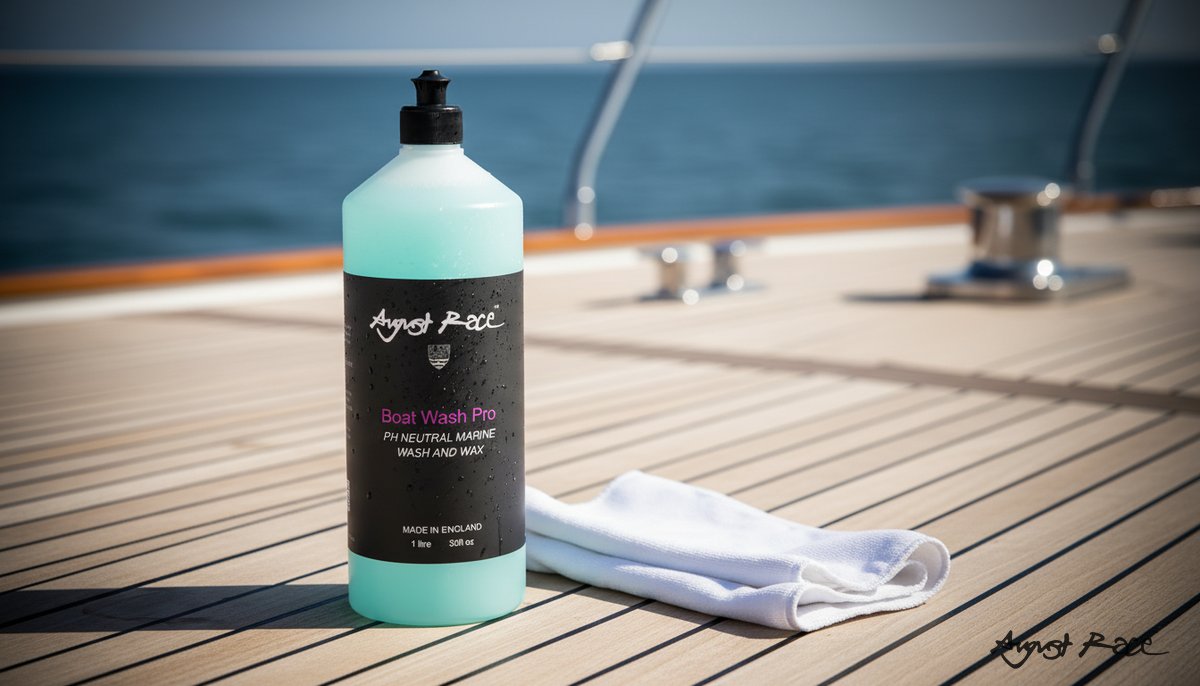
Remove Salt Buildup & Algae: Boat Wash Pro Gelcoat Care
Cut salt, lift algae, and keep gelcoat glossy with August Race Boat Wash Pro -- an easy, streak-free boat cleaning routine for yachts and RIBs.
UV Protection for Boats: Shield Every Surface from Sun Damage
Protect every boat surface from UV damage. Comprehensive guide covering gelcoat, vinyl, inflatable tubes, teak, canvas, and rubber fender UV protection strategies.