UV protection for boats is the practice of shielding every exposed surface — gelcoat, vinyl, inflatable tubes, canvas, and hardware — from ultraviolet radiation using a combination of physical barriers and chemical protectants applied on a schedule matched to your climate and usage pattern. Unlike salt or marine growth, UV damage cannot be washed off. It accumulates invisibly until surfaces fade, crack, or chalk — and by that point, you are paying for restoration instead of prevention.
I have spent 15 years watching the sun quietly destroy boats. Not storms, not collisions — just sunlight, doing its work day after day while the boat sits at the dock. The boats that still look sharp after a decade are not lucky. They have owners who understand that UV protection is not a one-time job but an ongoing system. This guide covers what that system looks like for every surface on your boat.
How UV Damages Boat Surfaces
UV radiation does not just fade color. At the molecular level, UV photons break the polymer chains that give materials like gelcoat, vinyl, and rubber their strength and flexibility. In polymer science, this process is called chain scission — UV energy snaps the chemical bonds holding the material together (PCI Magazine). Over time, the surface becomes brittle, chalky, and structurally weaker.
What makes UV damage especially dangerous is that it is cumulative and irreversible. Each hour of unprotected sun exposure adds to the total damage. There is no recovery — only prevention or restoration. And restoration gets expensive quickly: professional gelcoat compounding runs $10-50 per foot depending on severity and your market, vinyl seat reupholstering costs $200-1,000 per seat, and full hull re-gelcoating can cost $1,500-5,000+ depending on boat size and condition.
Why Climate Matters Less Than You Think
If you keep your boat in the Pacific Northwest and assume UV is not a concern, think again. Up to 80% of UV radiation penetrates cloud cover. Water reflection adds roughly 10% more UV exposure on top of direct sunlight, according to World Health Organization data. That compounding effect is why boat surfaces degrade faster than the same materials would on land. Florida boats take more total UV per year, but boats everywhere accumulate damage over a season.
The difference is schedule, not whether to protect at all.
How to Assess Your Boat's UV Exposure Risk
Before buying products, understand where your boat falls on the UV exposure spectrum. Three factors determine your risk level:
Factor 1: Regional UV Index
| Region | Avg Summer UV Index | Annual UV Exposure | Wax Reapplication |
|---|---|---|---|
| South Florida / Gulf Coast | 10-12 (Extreme) | Very High | Every 2-3 months |
| Mid-Atlantic / Chesapeake | 7-9 (High) | High | Every 3-4 months |
| Great Lakes / Pacific NW | 5-7 (Moderate) | Moderate | Every 4-6 months |
| New England / Upper Midwest | 4-6 (Moderate) | Moderate-Low | Twice per season |
These are seasonal averages accounting for cloud cover. On clear summer days, peak UV can run 2-3 points higher — Seattle and Boston both hit UV index 8-9 on sunny July afternoons. Protect for the peaks, not the averages.
Factor 2: Storage Type
Your storage setup is the single biggest variable. A boat under a covered slip or in a boathouse gets a fraction of the UV exposure of one sitting on an open trailer in a parking lot.
- Covered marina / boathouse: Lowest UV exposure. Protection products last longest.
- Open slip (in-water): Full sun exposure during the day, but waterline and lower hull shielded.
- Open trailer / dry stack: Full exposure on all surfaces, plus reflected UV from pavement.
Factor 3: Surface Vulnerability Ranking
Not every surface degrades at the same rate. Here is the rough order from most to least vulnerable:
- Vinyl upholstery — plasticizer loss begins within months of unprotected exposure
- Clear vinyl windows — hazing and brittleness
- PVC inflatable tubes — faster degradation than Hypalon
- Hypalon inflatable tubes — more UV-resistant than PVC but still needs protection
- Unprotected gelcoat — chalking and oxidation over 1-3 years
- Canvas / Sunbrella fabric — color fading, thread weakening
- Teak and brightwork — graying and surface fiber breakdown
- Waxed or sealed gelcoat — slowest degradation when properly maintained
Surface-by-Surface Protection Strategy
This is where UV protection gets specific. Each material needs a different product and approach. Using gelcoat wax on vinyl seats or vinyl protectant on inflatable tubes will not work — and can actually cause damage.
Gelcoat: Wax, Sealant, or Both
Gelcoat is a polyester resin finish designed to be the first line of defense on fiberglass boats. When it is healthy and protected, it is remarkably durable. When UV breaks down its surface, the result is the chalky, faded look that screams "neglected boat."
You have three main options for gelcoat UV protection:
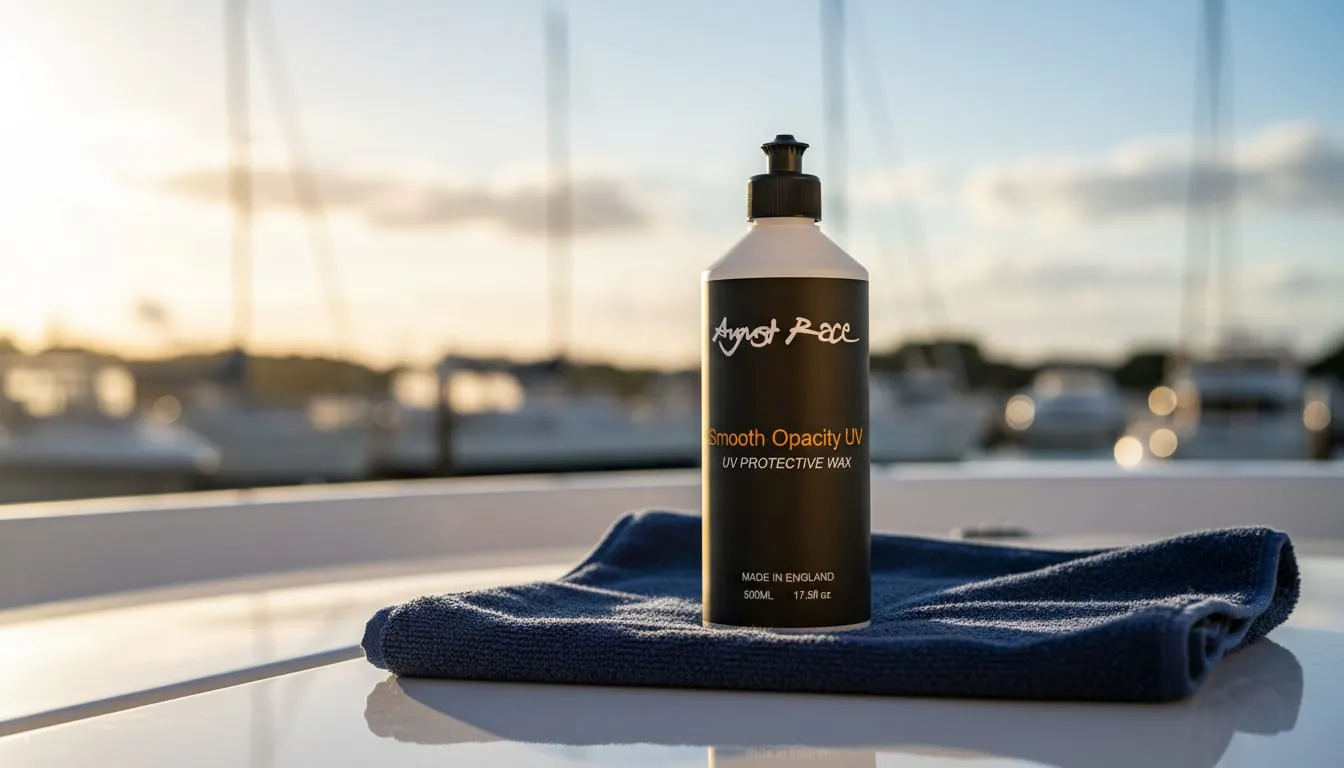
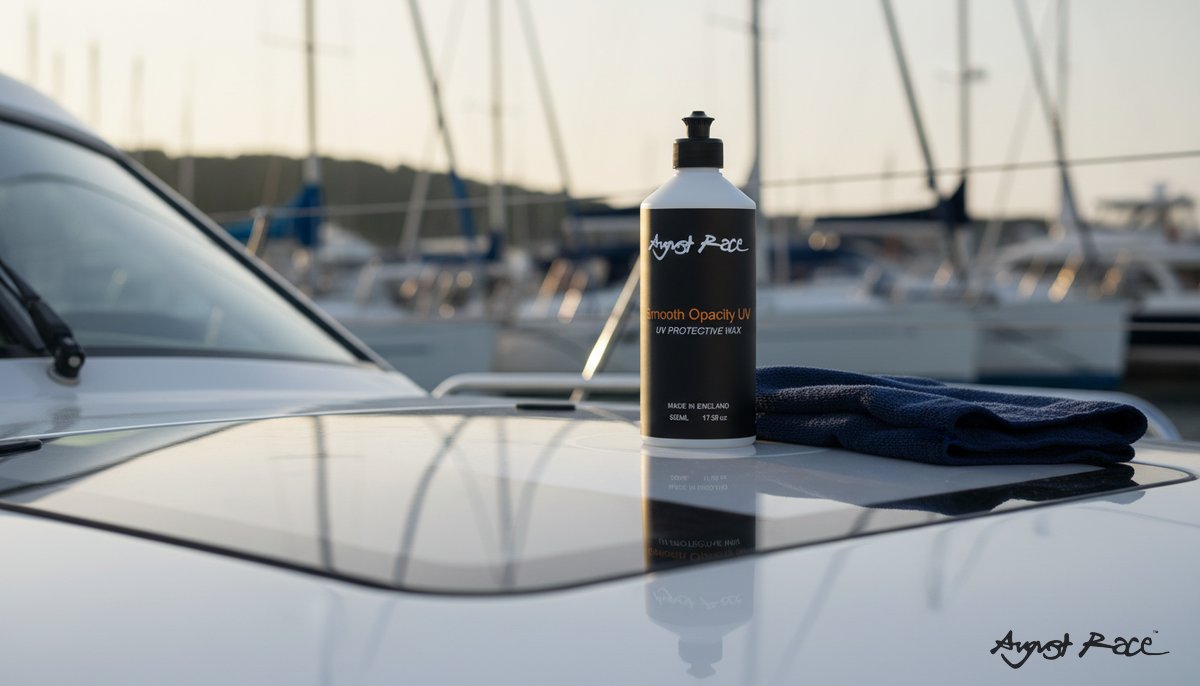
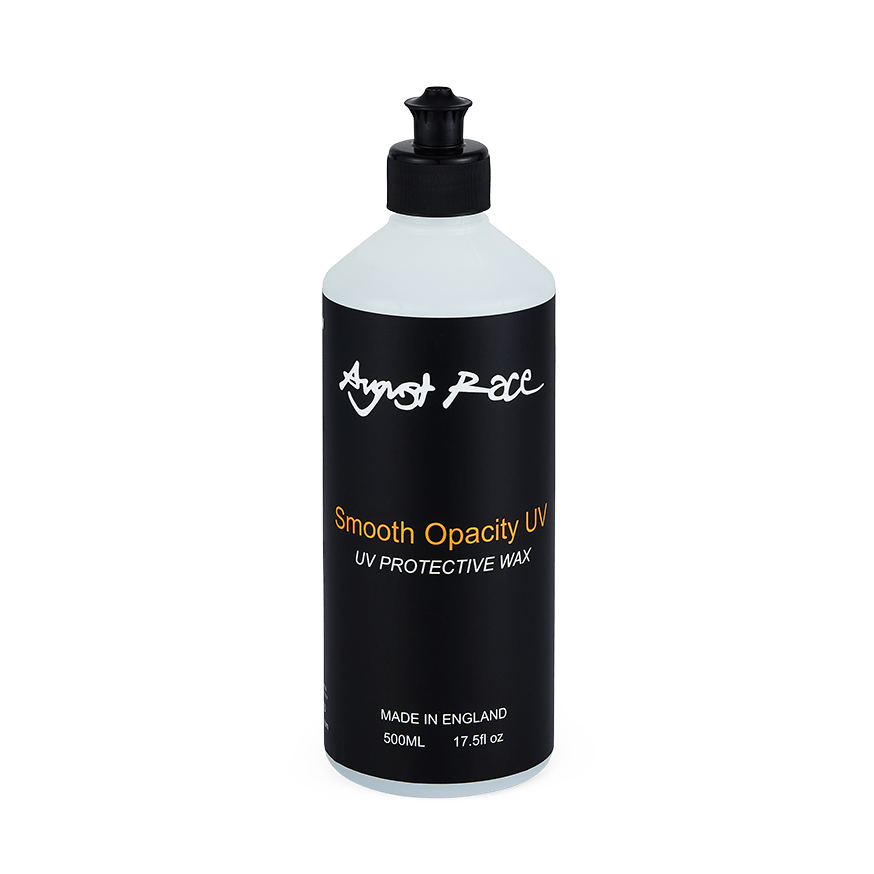
Wax creates a sacrificial barrier that absorbs UV energy before it reaches the gelcoat. It provides excellent gloss and water beading but wears off in 1-3 months depending on climate. Smooth Opacity UV is a marine wax formulated specifically with UV absorbers — our application guide covers the full process including surface prep and reapplication timing.
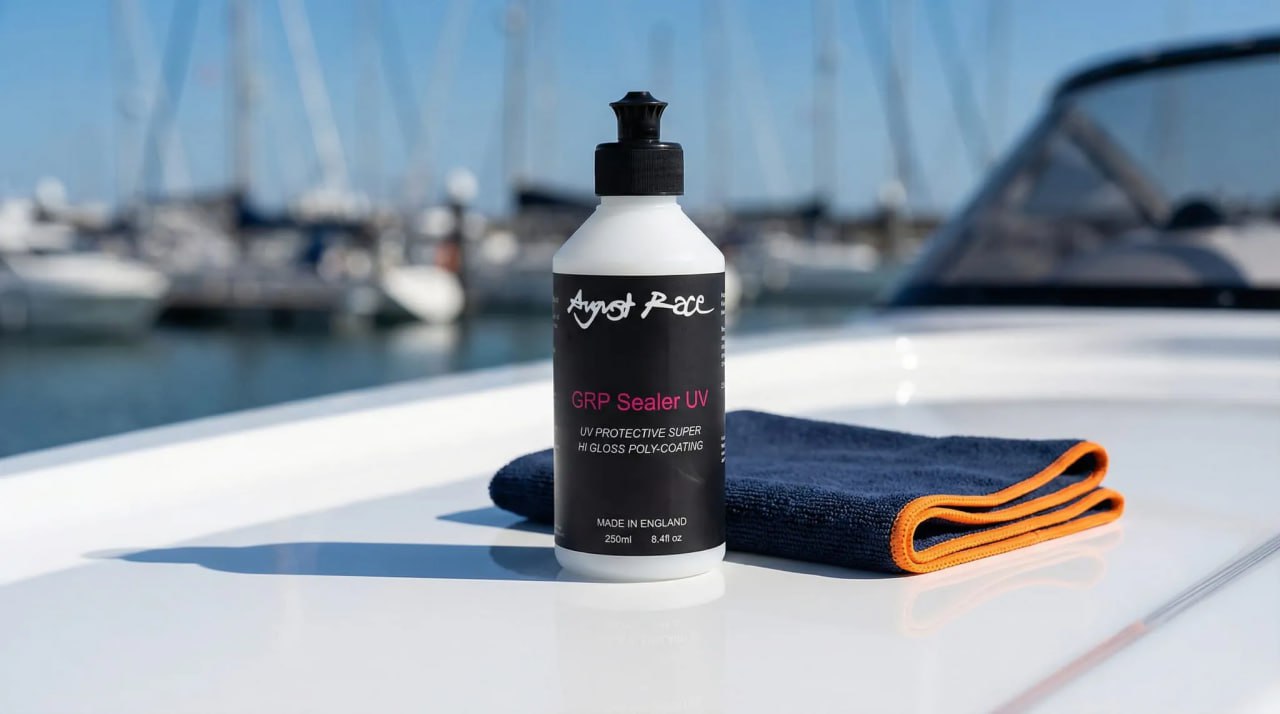
Sealant forms a chemical bond with the gelcoat surface, creating a harder and longer-lasting protective layer — typically 3-6 months. GRP Sealer UV is designed for this purpose. Our sealant application guide walks through prep, application, and cure times step by step.
Layered approach (recommended): Apply sealant as the base layer, then wax on top. The sealant does the heavy lifting on UV protection and durability. The wax adds gloss, water beading, and an extra sacrificial layer. When the wax wears off, the sealant is still protecting the gelcoat underneath.
For a detailed comparison of wax types, longevity, and which products work best for different conditions, see our boat wax buyer's guide. For the broader GRP protection strategy, our GRP UV protection overview covers the full picture.
If your gelcoat already shows chalking or fading, that is oxidation — you need to address it before applying protection. See our oxidation removal guide for the full restoration process.
Vinyl Upholstery and Seats
Vinyl is the surface I see neglected most often. People wax their hull religiously and then ignore the seats until they crack.
UV radiation accelerates plasticizer loss in vinyl. Plasticizers are the chemicals that keep vinyl soft and flexible. As UV breaks them down, the vinyl becomes stiff, then brittle, then cracks. Practical Sailor's testing found that wax does not slow plasticizer migration and provides no meaningful UV screening on vinyl (Practical Sailor). What does help is a dedicated vinyl protectant applied regularly — it seals the pores, keeps dirt and moisture out, and makes future cleaning easier, all of which slow the visible degradation cycle.
Protection approach:
- Clean vinyl first — dirt particles trapped under protectant act like sandpaper. Vinyl Bright cleans and restores in one step.
- Apply UV protectant after cleaning. Work it into the vinyl with a clean microfiber cloth — not a sponge, which pushes grime into the pores.
- Reapply monthly during boating season, or after every heavy wash.
If your vinyl already has mildew staining, that is a different problem — our mildew prevention guide covers cleaning and ongoing prevention.
Inflatable Tubes: PVC and Hypalon
If you run a RIB or any boat with inflatable tubes, UV protection is not optional. PVC tubes are especially vulnerable — they degrade faster than Hypalon under UV exposure and are harder to restore once damaged. Hypalon holds up better but still needs protection to maintain flexibility and prevent surface cracking.
LR Sealer UV is formulated specifically for inflatable tube materials. Apply with a clean microfiber cloth in small sections — a little goes a long way. Our RIB tube UV protection guide covers the full application process for both PVC and Hypalon tubes, including how to tell which material your tubes are made of.
Key points for inflatable tube UV care:
- Never use gelcoat products on tubes. Wax and sealant are formulated for hard gelcoat — on flexible tube material they leave residue, provide no meaningful UV protection, and can interfere with tube-specific protectants.
- Apply protection to dry tubes. Moisture trapped under sealer creates white spots and reduces adhesion.
- Work in small sections (about 3 feet at a time). Product dries fast on tube material, especially in warm weather.
- Reapply monthly during boating season in any climate.
Canvas, Bimini Tops, and Fabric Covers
Canvas and Sunbrella fabric contain UV stabilizers from the factory, but these diminish over time with washing and sun exposure. When the stabilizers wear out, the fabric fades, the thread weakens, and seams start to fail.
Protection approach:
- Re-treat fabric with a marine fabric guard product after every deep cleaning or annually at minimum
- Never pressure-wash canvas — it strips the factory UV coating faster than anything else
- Store canvas loosely when possible; tight folding in a hot locker accelerates creasing and UV stress at fold points
Canvas is your boat's first physical barrier against UV, so protecting the protector pays dividends across every other surface.
Fenders and Rubber Components
Fenders, rub rail inserts, and dock line chafe guards are PVC or rubber — both degrade under UV. Fenders in particular spend their life exposed to sun, salt, and dock grime. Regular cleaning with a dedicated fender cleaner like Fender Clean removes embedded dirt and the sticky plasticizer bleed that attracts more grime. Clean fenders degrade slower because the dirt itself accelerates UV damage by trapping heat against the surface.
Teak and Brightwork
Teak grays when exposed to UV — that is the surface wood fibers breaking down. While some owners prefer the gray patina, unprotected teak eventually develops surface cracking and fiber separation. Teak oils, sealers, and varnish all provide UV protection at different durability levels. This is a specialized topic outside the scope of marine detailing products, but the principle is the same: periodic reapplication on a schedule matched to your UV exposure.
The Protection Stack: Physical Barriers + Chemical Products
The most effective UV protection combines physical barriers with chemical products. Neither one alone is sufficient for a boat that gets regular use.
Physical barriers (covers, bimini tops, boathouses) block UV entirely when the boat is not in use. A quality fitted cover is the single highest-impact UV protection investment you can make. It protects every surface simultaneously — gelcoat, vinyl, canvas, electronics, everything.
Chemical products (wax, sealant, vinyl protectant, tube sealer) protect during active use when covers are off. They provide the protection layer between your surfaces and the sun while you are actually on the water.
Why you need both:
- A cover cannot protect the boat while you are using it
- Chemical products cannot match a cover's protection while the boat sits idle
- Together, they reduce total UV exposure by the largest possible margin
The common mistake is relying on only one approach. I see boats with perfect wax jobs that sit uncovered in open storage all week — the wax burns off in half the time it should. And I see covered boats where the owner never waxes because "the cover handles it" — then wonders why the gelcoat looks dull after a few seasons of weekend use.
Reapplication Schedule by Climate and Surface
This is the table I wish someone had given me when I started. Every surface has a different reapplication window, and your climate shifts that window significantly.
| Surface | High UV (FL, Gulf) | Moderate UV (Mid-Atlantic, Great Lakes) | Low UV (PNW, New England) |
|---|---|---|---|
| Gelcoat wax | Every 2-3 months | Every 3-4 months | Every 4-6 months |
| Gelcoat sealant | Every 3-4 months | Every 4-6 months | Every 6 months |
| Vinyl protectant | Monthly | Monthly | Every 6-8 weeks |
| RIB tube sealer | Monthly | Monthly | Every 6-8 weeks |
| Canvas treatment | Annually + after washing | Annually | Annually |
Signs your protection has worn off:
- Gelcoat: Water no longer beads on the surface. Instead it sheets or sits flat. This is the simplest test — spray the hull with a hose and watch what the water does.
- Vinyl: Surface feels dry or tacky to the touch instead of smooth. Early cracking at flex points (where seats bend when sat on).
- Tubes: Material feels rough or chalky. Color looks lighter than usual, especially on colored tubes.
Common UV Protection Mistakes
1. Applying Products in Direct Sunlight
Product flashes off before it can bond to the surface. You waste product and get uneven coverage. Always apply in shade or during cooler parts of the day — morning or late afternoon.
2. Using One Product on Multiple Surface Types
Gelcoat wax on vinyl seats traps dirt and does nothing for plasticizer protection. Vinyl protectant on gelcoat leaves a greasy film that attracts dirt. Match the product to the surface.
3. Skipping "Minor" Surfaces
Fenders, dock line chafe guards, rubber rub rail inserts, instrument bezels, plastic hatches — these all degrade under UV. They are also expensive to replace. A wipe-down with the appropriate protectant during your regular detail takes five minutes.
4. Assuming a Cover Alone Is Enough
Covers protect when the boat is stored. Every hour of use without chemical protection counts toward cumulative UV damage. Even a moderate weekend boater in Florida racks up 200-400 hours of sun exposure per season — every one of those hours counts.
5. Pressure-Washing Before Protecting
Pressure washing strips existing wax, sealant, and factory UV coatings from canvas and vinyl. If you must pressure-wash, always reapply protection immediately afterward. For routine cleaning, a pH-neutral wash like Boat Wash Pro is far less aggressive and preserves existing protection layers.
6. Waiting Until Damage Is Visible
By the time gelcoat looks chalky or vinyl feels stiff, you have months of accumulated damage to undo. Prevention is always cheaper than restoration. Stick to your reapplication schedule even when the boat looks fine.
Frequently Asked Questions
What boat surface is most vulnerable to UV damage?
Vinyl upholstery is the most UV-sensitive common boat surface. UV radiation accelerates plasticizer loss — the chemical process that keeps vinyl soft and flexible. Without protection, vinyl can begin showing cracking within a few seasons of regular sun exposure, faster in high-UV climates. Inflatable tubes (especially PVC) and unprotected gelcoat are the next most vulnerable surfaces.
Does my boat need UV protection in cloudy climates?
Yes. Up to 80% of UV radiation penetrates cloud cover, according to dermatological research. Boats in the Pacific Northwest or Great Lakes receive less total UV than Florida, but cumulative seasonal damage still occurs. Protection schedules can be less frequent but should never be eliminated entirely.
How often should I reapply UV protection on my boat?
It depends on your climate and the product type. In high-UV regions like Florida, reapply wax every 2-3 months and check sealants quarterly. In moderate-UV regions, every 4-6 months is typically sufficient. Vinyl protectant and RIB tube sealer should be reapplied monthly during boating season in any climate.
Can I combine a boat cover with UV coatings?
Yes, and this combination is the most effective approach. A cover blocks direct UV when the boat is docked or stored, while chemical coatings protect during active use. Together, they can extend surface life significantly compared to either method alone.
Is there a single product that protects everything on my boat from UV?
No. Each boat surface has different chemistry and requires a product designed for that material. Gelcoat needs wax or sealant, vinyl needs a dedicated protectant, inflatable tubes need tube-specific UV sealer, and canvas needs fabric treatment. Using the wrong product on a surface is often worse than using nothing at all.
What is the difference between boat wax and boat sealant for UV protection?
Wax creates a sacrificial barrier that sits on top of the gelcoat, absorbing UV energy and washing away over 1-3 months. Sealant bonds chemically to the surface and provides a harder, longer-lasting shield — typically 3-6 months or more. Many boat owners use both: sealant as the base layer and wax on top for added gloss and an extra UV barrier.
Does UV damage affect aluminum boats?
Aluminum itself is resistant to UV degradation — it does not chalk or oxidize from sunlight the way gelcoat does. However, painted aluminum hulls, vinyl upholstery, canvas, and any plastic or rubber components on an aluminum boat are all vulnerable to UV damage and need the same surface-specific protection as on fiberglass boats.
Explore Guides
Best Boat Wax for Oxidation Protection: Buyer's Guide
Find the best boat wax for oxidation protection. Compare marine waxes, sealants, and hybrid products. Learn what makes a boat wax effective against UV damage.
Read guideHow to Apply Boat Sealant: Gelcoat Protection Guide
Professional guide to applying gelcoat sealant on fiberglass boats. Covers surface prep, application technique, cure times, and maintenance for lasting UV protection.
Read guideRIB UV Protection: How LR Sealer UV Protects Tubes
Guide to RIB UV protection using LR Sealer UV -- PVC tube sealer and Hypalon UV treatment to prevent UV cracking and reduce cleaning.
Read guideSmooth Opacity UV: Pro UV Protection Boat Wax Guide
A marine tech’s guide to Smooth Opacity UV -- UV protection boat wax and hydrophobic boat polish for gelcoat. Improve gloss, repel water, and extend service...
Read guideGRP UV Protection: August Race GRP Sealer UV Guide
Protect fiberglass boats from UV with a hydrophobic, eco-friendly GRP sealer. Prep, application, maintenance tips, and FAQs on water spots and durability.
Read guideAbout the Expert

Alex Martinez
Charter Captain & Marine Detailer
After 15 years running charter boats, Alex transitioned into professional marine detailing. He brings hands-on experience with every kind of boat problem salt water can throw at you.
“Salt water finds every shortcut you took.”
Get Expert Tips
Subscribe for marine care insights and product updates from industry professionals.
No spam. Unsubscribe anytime.
You May Also Like
Gelcoat Waxing Guide: How to Apply Marine Wax for UV Protection
Learn the right way to wax your boat's gelcoat for lasting UV protection. Step-by-step process for surface prep, wax application, and long-term maintenance.
Boat Oxidation Removal: The Complete Guide to Restoring Gelcoat
Everything you need to know about boat oxidation. How it happens, how to assess severity, step-by-step removal methods, and long-term prevention strategies.
Complete Guide: How to Remove Oxidation from Boat Gelcoat
Master boat oxidation removal with this complete guide. Learn to identify oxidation severity, choose the right compounds, and protect your gelcoat for lasting results.