Inflatable boat care is the ongoing maintenance of RIB (rigid inflatable boat) and inflatable dinghy tubes, including cleaning, UV protection, pressure management, and material-specific treatment matched to whether your tubes are Hypalon (CSM) or PVC. The core principles apply whether your boat has a rigid fiberglass hull with bonded pontoons or a fully inflatable soft floor. Proper care extends Hypalon tube life to 15-20 years and PVC to 5-10 years. Neglected tubes fail in a fraction of that.
I run charter boats, and the tubes are the first thing clients notice and the last thing most owners think about. Over 15 years in salt water, I have replaced more tubes than I care to count. Nearly every replacement was preventable. The owners who keep their tubes in good shape do the basics on a schedule instead of waiting for problems to get expensive.
Why Tube Care Matters
A year of cleaning and UV protection products costs $50 to $100. A retube runs $1,500 to $5,000. That is a 15:1 to 100:1 return on a few hours of seasonal work. Tube condition also drives resale value: buyers inspect tubes first because they know what replacement costs.
Tube maintenance comes down to two product categories: a dedicated inflatable cleaner for regular washing, and a tube-specific UV sealer for protection between uses. This guide covers the decisions around both: what material your tubes are, how to assess condition, what schedule fits your climate, and when to repair versus replace. For step-by-step processes, I point you to our specific guides on each topic.
How Environment Degrades Inflatable Tubes
The same UV radiation that oxidizes fiberglass gelcoat attacks tube materials, but on flexible substrates the damage looks different.
UV photons cause polymer chain scission, snapping the molecular bonds holding the material together (Gewert et al., Environmental Science: Processes & Impacts, 2015). In gelcoat, this produces chalking. In tube material, it causes stiffening, cracking, and structural failure. PVC takes the worst of it because UV accelerates plasticizer migration: the compounds that keep PVC soft and flexible get driven out by heat and sunlight, leaving the tube brittle and crack-prone. PVC tubes in high-UV climates can feel stiff and waxy after just a few unprotected seasons.
Hypalon (CSM rubber) has better inherent UV stability, which is why it costs more and lasts longer. But Hypalon tubes are glued, not welded, and seam adhesives degrade faster than the tube material itself. A Hypalon boat with solid tube fabric but failing seam adhesive is common after 10 years.
Salt accelerates all of this. Salt crystals hold moisture against the tube surface, amplifying UV damage, weakening adhesives, and promoting mildew. A five-minute freshwater rinse after every use interrupts the cycle.
Hypalon vs PVC: Know Your Tube Material
Every maintenance decision starts here. Using the wrong product on the wrong material wastes money at best and damages tubes at worst.
What Is Hypalon (CSM)?
Hypalon is DuPont's trade name for chlorosulfonated polyethylene (CSM), a synthetic rubber. DuPont stopped manufacturing it in 2009, but the name stuck and several manufacturers produce equivalent CSM fabrics today. Hypalon tubes are glued rather than welded, so seam maintenance matters more over the boat's life.
Hypalon characteristics:
- Superior UV resistance compared to PVC
- Handles temperature extremes better (does not stiffen as much in cold, does not soften as much in heat)
- Can be repaired with glued patches that bond permanently to the material
- Lifespan of 15 to 20 years with proper care (Newport Vessels)
- Higher initial cost (roughly 2 to 3 times more than equivalent PVC boats)
- Surface dulls and develops a matte texture over time (cosmetic, not structural)
What Is PVC?
PVC (polyvinyl chloride) is the more common and affordable tube material. PVC tubes are heat-welded at the seams, creating strong initial bonds but with greater susceptibility to UV degradation, heat softening, and solvent damage.
PVC characteristics:
- Lower cost, making it the standard material on entry-level and mid-range RIBs
- Heat-welded seams require no adhesive maintenance
- More vulnerable to UV: plasticizers break down faster under sun exposure
- Lifespan of 5 to 10 years with proper care, shorter in high-UV climates (Rafting Escapes)
- Stiffer in cold weather, softer in extreme heat
- Maintains a glossy appearance longer (though this is partly because PVC degrades differently, not because it is healthier)
How to Identify Your Tube Material
Manufacturer documentation specifies the material. For used boats or missing paperwork, two field tests work reliably (Polymarine):
The sandpaper test: Sand a small, hidden area (inside a D-ring patch or under a grab rope mount) with 120-grit sandpaper. Hypalon turns dull, produces a fine dust, and develops a suede-like nap. PVC scratches but remains glossy with no texture change.
The solvent test: Apply a small amount of MEK (methyl ethyl ketone) or acetone to a hidden area with a cotton swab. PVC becomes tacky and soft within 30 seconds. Hypalon shows no reaction. Always do this test in a concealed spot, as the solvent can leave a mark on PVC.
Your material determines which products, adhesives, and protectants to use. Every recommendation in this guide specifies material compatibility.
Assessing Tube Condition
Evaluate where your tubes stand before choosing a maintenance plan. Catching problems early is the difference between a $30 bottle of protectant and a $3,000 retube.
Visual Indicators
Healthy: Consistent color, supple material, no cracks at fold points or valve bases. Slight sheen (Hypalon may be matte, PVC slightly glossy).
Early degradation: Color fading on sun-facing surfaces. Slightly rough or chalky to the touch but still flexible. The ideal time to intervene with cleaning and UV protection.
Moderate degradation: Visible color differences between sun-exposed and shaded areas. Fine cracking at flex points, D-rings, and valve bases. Material has stiffened. PVC progresses faster here than Hypalon. See our tube UV protection guide for treatment at this stage.
Severe degradation: Deep cracks at seams and high-stress points. Brittle, dramatically faded or gray material. On Hypalon, this can sometimes be reversed: our Hypalon restoration guide covers the process.
Pressure Test
Use a low-pressure gauge (standard tire gauges lack accuracy at RIB pressures). Most manufacturers specify 3.0 to 3.5 PSI (0.2 to 0.25 bar) for main tubes (Power & Motoryacht). Inflate to spec and recheck after 24 hours. Losing more than 0.5 PSI overnight means a slow leak that needs attention.
Seam Inspection
Run your fingers along every seam, valve, D-ring, and patch. Feel for lifting edges, hardened adhesive, or soft spots. On Hypalon, seam adhesive dries out and loses grip over years of UV exposure. On PVC, welded seams are more stable but can fail at stress points.
The soapy water test finds active leaks: spray along seams and watch for bubbles. Be systematic. The leak you miss is the one that strands you.
Valve Inspection and Maintenance
Valves are the number one cause of slow air loss, and the component most owners overlook. Sand, grit, and salt work into the valve seat over time, preventing a complete seal.
Inspect by:
- Pressing the valve spring with a valve key or dowel. It should return with firm, consistent tension. Weak or sticky means the internals need cleaning or replacing.
- Checking inside the valve body with a flashlight for debris or corrosion.
- Applying soapy water around the closed valve under pressure. Bubbles mean a compromised seal.
Cleaning: Unscrew the valve insert with the correct key for your brand. Flush the body and insert with fresh water, wipe rubber sealing surfaces, reinstall, and test. Five minutes per valve, solves most slow leaks.
Replacement: If the spring has lost tension, the seal is cracked or compressed flat, or the body is corroded, replace the insert. Common brands (Halkey-Roberts, Bravo) run $15 to $30 and are a straightforward DIY job (Polymarine Valve Guide).
Cleaning: The Foundation of Tube Care
Dirt, salt, and organic residue on tube surfaces trap heat and moisture, accelerating UV degradation. A clean tube lasts measurably longer.
Cleaning Principles
Rinse after every use. Five minutes of fresh water removes salt and grime before they cause damage, preventing the buildup that leads to expensive deep cleaning.
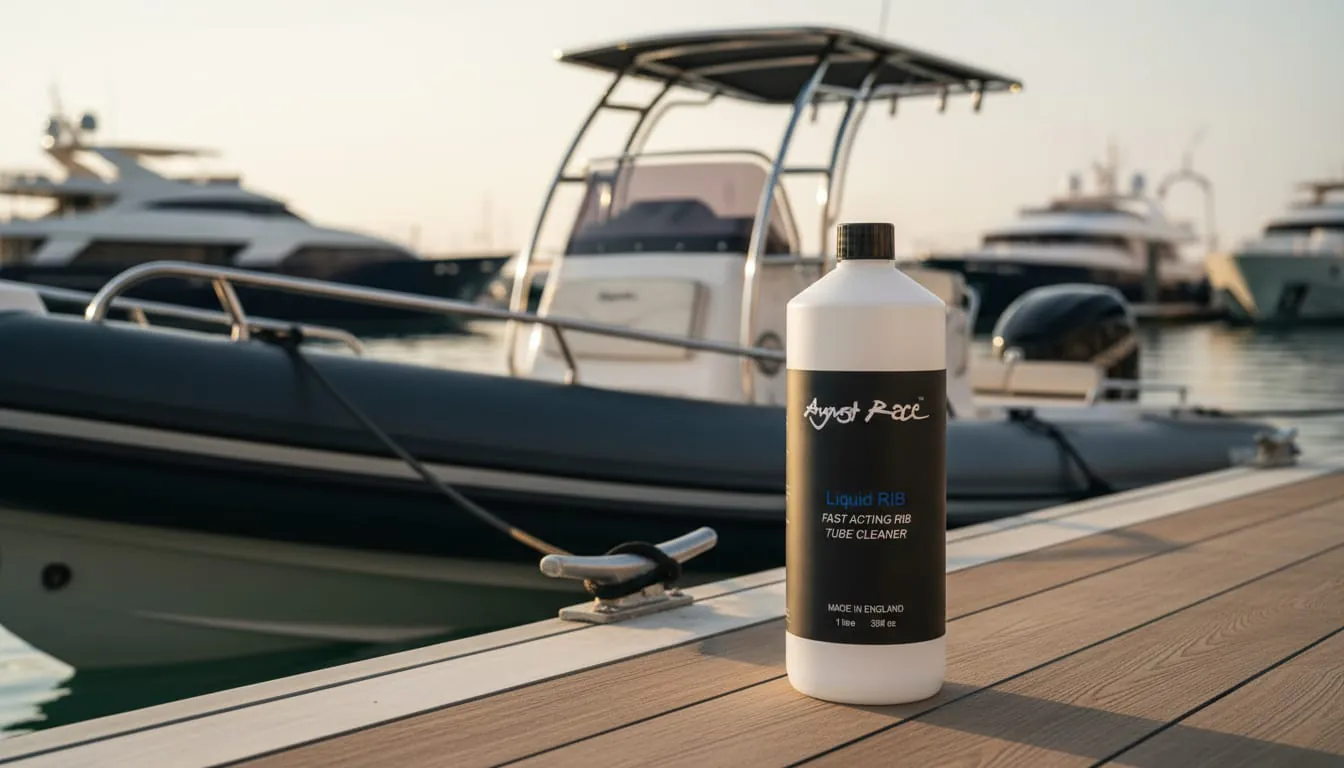
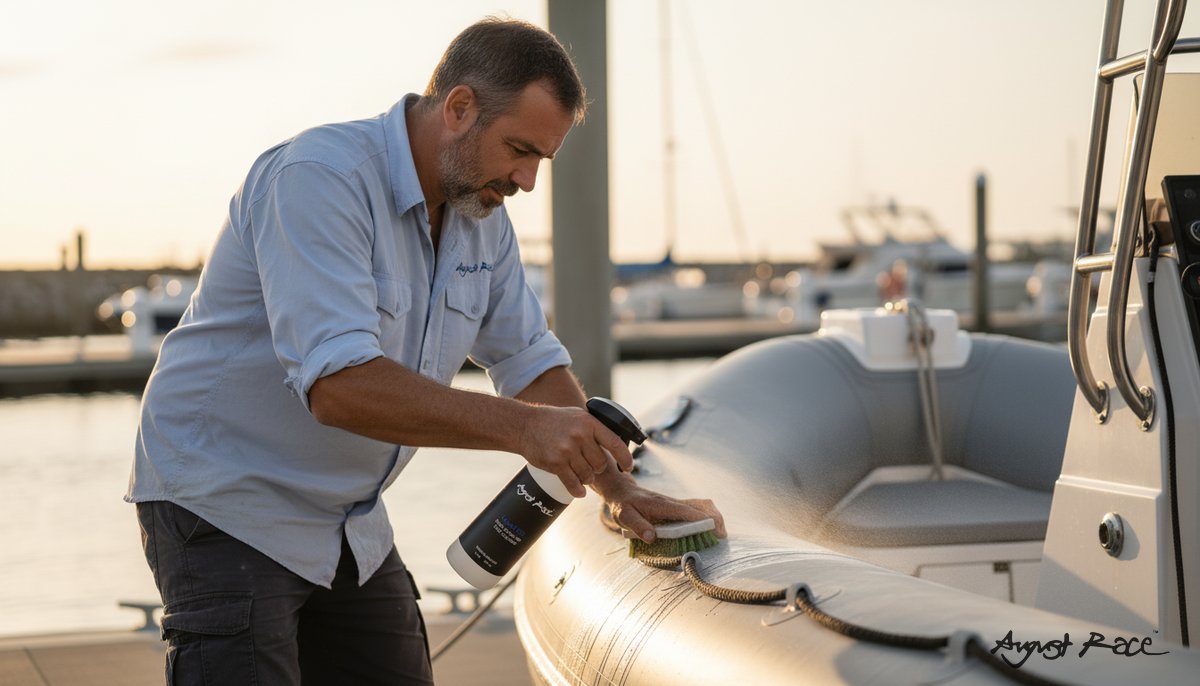
Use tube-specific cleaners. General boat soap handles light maintenance, but Practical Sailor's testing found that dedicated inflatable cleaners are worth the extra cost: they clean without harming tube surfaces (Practical Sailor). Liquid RIB cleans without leaving residue that attracts dirt or interferes with UV protectant adhesion. For the full cleaning process, see our inflatable cleaning guide.
No pressure washers. The concentrated stream delaminates fabric coatings, forces water into material layers, and stresses seam adhesives. Zodiac's own guidelines warn against it (Zodiac Nautic). Use a garden hose, soft brush, and patience.
No solvents, bleach, or abrasives. Solvents soften PVC. Bleach weakens fibers and adhesives. Abrasives scratch the surface, creating grooves where dirt and moisture collect.
For the rigid hull and deck, a pH-neutral wash like Boat Wash Pro handles fiberglass without affecting tube material.
UV Protection and Sealing
The foundation of inflatable tube maintenance is a two-step sequence: clean first, then protect. Applying UV protectant to a dirty tube reduces adhesion and shortens its effective life. Every maintenance session follows this order, from quick post-use rinses to full seasonal treatments. UV is the primary driver of tube failure for both materials, and the good news: it is the most preventable form of damage.
Why Tube-Specific UV Protection Matters
Gelcoat wax and sealant do not work on tubes. They are formulated for hard, non-porous surfaces. On flexible material, they crack with tube movement, trapping moisture underneath.
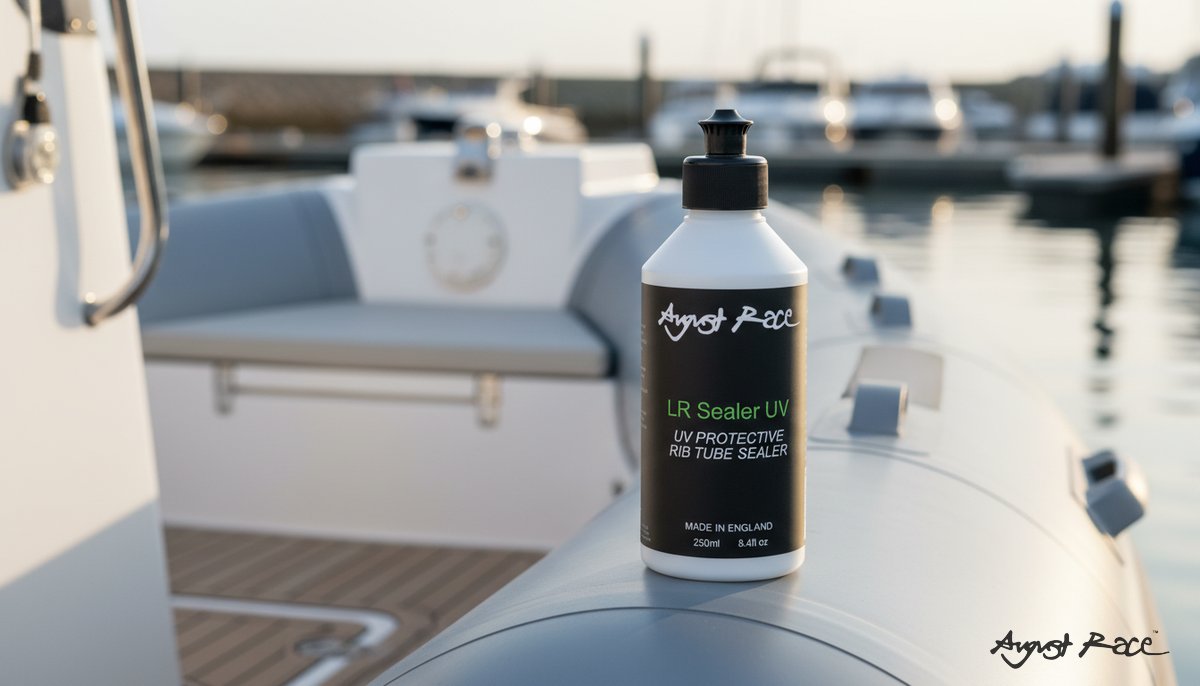
LR Sealer UV is formulated for inflatable tube materials. It penetrates rather than sitting on top, maintaining flexibility while blocking UV. Our application guide covers the process for both Hypalon and PVC.
Protection Schedule
Apply UV protectant to clean, dry tubes monthly during boating season. In high-UV regions (Florida, Gulf Coast, Southern California), every 3 to 4 weeks. Our UV protection guide covers reapplication schedules by climate zone across all boat surfaces.
Physical Protection
Chemical protectant handles use days. Physical barriers handle the rest:
- Tube covers (chaps): The single most effective investment for boats in open slips. Fitted fabric shields tubes from direct UV at the dock.
- Boat covers: Block UV from all surfaces at once.
- Covered storage: Near-zero UV exposure when the boat is idle.
Combining both approaches maximizes tube lifespan in any climate.
Seasonal Maintenance Schedule
Frequency depends on your climate and sun exposure.
| Task | South FL / Gulf Coast | Mid-Atlantic / Chesapeake | Great Lakes / PNW | New England |
|---|---|---|---|---|
| Fresh water rinse | After every use | After every use | After every use | After every use |
| Full cleaning | Every 2-3 weeks | Every 3-4 weeks | Monthly | Monthly |
| UV protectant application | Every 3-4 weeks | Monthly | Monthly | Monthly during season |
| Pressure check | Weekly | Bi-weekly | Bi-weekly | Bi-weekly |
| Valve inspection | Monthly | Every 6 weeks | Every 2 months | Start and mid-season |
| Seam inspection | Monthly | Every 6 weeks | Every 2 months | Start and mid-season |
| Full condition assessment | Quarterly | Twice per season | Start and end of season | Start and end of season |
| Winterization | N/A (year-round boating) | Late October | Late October | Early October |
For a complete seasonal prep walkthrough, including spring commissioning checklists, see our spring RIB prep guide.
Temperature and Pressure Management
Air expands when heated and contracts when cooled. A tube at 3.5 PSI in cool morning air can exceed safe limits on a hot afternoon, stressing seams.
Rule of thumb: Inflate in the conditions you will use the boat. If you inflate in a cool garage and launch into 95°F heat, recheck pressure after an hour in the sun.
Winterization Essentials
Proper winter layup prevents more damage than most owners realize.
Before storage: Clean tubes thoroughly, then apply UV protectant. This protects the material over winter and gives you a clean surface come spring.
Deflation and positioning: Reduce pressure by about one-third to relieve seam stress, but do not fully deflate. Flat tubes develop permanent crease marks that become weak points. Rest the boat on the tubes (not the keel), on padded bunks or a clean, flat surface off bare ground.
Environment: Ventilation matters more than temperature. Sealed shrink-wrap without vent ports traps condensation against the tubes all winter, promoting mildew and adhesive breakdown.
Rodent protection: Mice chew through tube material to nest inside compartments. Stuff steel wool into openings, hatches, and drain holes. Place deterrents near (not touching) the tubes, and check manufacturer guidelines on chemical repellent compatibility with your tube fabric (BoatUS).
When spring arrives, reverse this process: inflate, inspect for winter damage, clean, and protect before the first outing. Our spring RIB prep guide walks through the full commissioning sequence.
Common Mistakes That Shorten Tube Life
1. Leaving Salt on Tubes
Salt holds moisture against the tube surface, accelerating every form of degradation covered in this guide. A five-minute fresh water rinse after every saltwater outing prevents it.
2. Storing Tubes Wet or Damp
Covering wet tubes creates a mildew incubator. The scrubbing required to remove mildew stains causes more damage than the mildew itself. Dry tubes before covering or storing. See our mildew prevention guide for treatment across all surfaces.
3. Over-Inflating Tubes
Running above manufacturer-recommended PSI puts constant stress on seams and valve fittings. In hot weather, thermal expansion can push seams past their design limits. Use a low-pressure gauge, not guesswork.
4. Using Automotive or Household Cleaners
Household cleaners contain solvents, bleach, or abrasives that damage tube materials. Automotive cleaners leave residue that traps heat and moisture on flexible surfaces. Use products designed for inflatables.
5. Ignoring Small Repairs
A small seam lift or pinhole is a 30-minute patch job. Left alone, it becomes structural failure. Hypalon patches bond permanently with the right adhesive. PVC needs heat-welding or PVC-specific adhesive. Either way, early catches stay cheap.
6. Dragging the Boat
Dragging a RIB across sand, gravel, or concrete grinds abrasive material into the tube surface, creating wear points where UV and moisture penetrate faster. Use a launching dolly or carry the boat.
7. Neglecting Trailer-Specific Tube Care
Trailered RIBs face wear patterns slip-kept boats never see. Bunk carpet wears through tube material at contact points over hundreds of launches. Check bunk carpet twice per season: worn or missing carpet exposes bare wood or metal.
Tie-down placement matters. Ratchet straps across tube seams concentrate pressure on the bond line. Route straps over solid tube sections, away from seams, with pads or wide webbing to distribute load. For road transport, tube covers cut UV exposure and keep bug splatter from baking on at highway speed.
When to Repair vs. When to Replace
This decision costs owners the most money when they get it wrong in either direction.
Repair Makes Sense When:
- Damage is localized: A puncture, small tear, or seam lift in one area with the rest of the tubes in good condition.
- Material is still flexible: The tube material around the damage bends without cracking. Flexibility means the material still has useful life.
- Adhesive is holding elsewhere: If seams are solid everywhere except the damaged area, a local repair has a good prognosis.
- The boat is under 10 years old (PVC) or under 15 years old (Hypalon): Within normal material lifespan, localized repairs are cost-effective.
Replacement Makes Sense When:
- Cracking is widespread: Multiple areas showing deep cracks, especially on sun-exposed surfaces. The material is failing systemically, not just in one spot.
- Material has lost flexibility throughout: Stiff, brittle tubes will crack at the next repair site even if you fix the current damage.
- Seam adhesive is failing in multiple locations (Hypalon): Re-gluing every seam is approaching retube cost and will not address underlying material degradation.
- The boat has been stored unprotected in a high-UV climate for years: Cumulative UV damage affects the entire tube, not just the visibly damaged areas.
Cost Framework
Retubing runs $1,500 to $5,000 depending on boat size and material. A comparable new RIB costs several times that. If the hull, transom, and console are structurally sound, retubing is the smarter financial call. The exception: boats with hull issues (transom delamination, significant fiberglass damage, or discontinued tube patterns).
Get a professional assessment before committing either way.
Product Recommendations
Three products cover tube maintenance for both Hypalon and PVC boats:
| Product | Works On | Primary Use | Frequency |
|---|---|---|---|
| Liquid RIB | Hypalon, PVC | Cleaning and restoration | Every 2-4 weeks |
| LR Sealer UV | Hypalon, PVC | UV protection and sealing | Monthly (every 3-4 weeks in high UV) |
| Boat Wash Pro | Fiberglass hull/deck | General wash (safe if overspray hits tubes) | After every use |
Each product has a detailed application guide linked in the section below.
Related Guides
- Boat Oxidation Removal: The Complete Guide to Restoring Gelcoat: For gelcoat oxidation on your RIB's hull
- UV Protection for Boats: Shield Every Surface from Sun Damage: Comprehensive UV protection across all surfaces
- Boat Mildew Prevention: Stop Mold Before It Starts: Preventing and treating mildew on boats
Frequently Asked Questions
How often should I clean my inflatable boat tubes?
Rinse tubes with fresh water after every use to remove salt, sand, and grime. Do a full cleaning with a dedicated inflatable boat cleaner every 2 to 4 weeks during boating season, or whenever visible dirt builds up. Salt left on tubes accelerates UV damage and material degradation regardless of whether you have Hypalon or PVC.
How do I tell if my RIB tubes are Hypalon or PVC?
The sandpaper test is the most reliable field method. Sand a small hidden area with fine-grit sandpaper. Hypalon turns dull, produces dust, and develops a suede-like texture. PVC scratches but stays glossy with no color change. You can also apply a small amount of MEK (methyl ethyl ketone) solvent to a hidden spot: PVC gets tacky and soft, while Hypalon is unaffected (Polymarine).
What PSI should RIB tubes be inflated to?
Most RIB manufacturers recommend 3.0 to 3.5 PSI (0.2 to 0.25 bar) for main tubes (Power & Motoryacht). Always check your specific manufacturer's recommendations, as over-inflation causes seam stress and under-inflation allows the tubes to flex excessively, accelerating wear. Temperature changes affect pressure: tubes inflated in cool morning air will increase pressure in afternoon heat.
How long do inflatable boat tubes last?
With proper maintenance, Hypalon (CSM) tubes last 15 to 20 years. PVC tubes typically last 5 to 10 years (Newport Vessels, Rafting Escapes). UV exposure is the biggest factor that shortens lifespan for both materials. Boats stored outdoors in high-UV climates without protection will fall at the lower end of those ranges regardless of material quality.
Can I use a pressure washer on inflatable boat tubes?
No. Pressure washers can damage tube seams, delaminate fabric coatings, and force water into the material layers. Use a garden hose and a soft brush or cloth with a dedicated inflatable boat cleaner. Zodiac's own maintenance documentation warns against high-pressure cleaning equipment (Zodiac Nautic).
How do I prevent mold on stored inflatable boat tubes?
Clean and dry tubes thoroughly before storage. Store in a ventilated area, not sealed in plastic or a tight locker where moisture gets trapped. If storing deflated, avoid tight folds that trap moisture in creases. A light application of UV protectant before storage helps prevent mildew from gaining a foothold on the tube surface. For comprehensive mildew prevention, see our mildew prevention guide.
Is it worth retubing a RIB or should I buy a new boat?
If the hull, transom, and console are structurally sound, retubing is almost always more cost-effective than replacing the entire boat. Retubing typically costs $1,500 to $5,000 depending on boat size and material, while a comparable new RIB costs several times that. The breakpoint is when the hull itself has structural issues like transom delamination or significant fiberglass damage.
Explore Guides
Spring RIB & Inflatable Prep: Tube Cleaning and UV Protection
A charter captain's field guide to spring RIB prep, covering inflatable tube inspection, proper cleaning for Hypalon and PVC, and UV protection that prevents costly tube replacement.
Read guideFast Inflatable Boat Cleaner: August Race Liquid RIB
Keep your tender pristine in minutes with an apply-and-wipe, no dwell time cleaner RIB owners trust. Remove salt, grime, and carbon marks from PVC tubes fast.
Read guidePrevent UV Cracking on RIB Tubes with LR Sealer UV
Prevent RIB tube fading and inflatable seam damage. LR Sealer UV adds PVC protection, helps stop UV cracking tubes, and supports winter prep for UV protectio...
Read guideRIB UV Protection: How LR Sealer UV Protects Tubes
Guide to RIB UV protection using LR Sealer UV -- PVC tube sealer and Hypalon UV treatment to prevent UV cracking and reduce cleaning.
Read guideRestore Hypalon Oxidation & Carbon Buildup on RIB Tubes
Clear oxidation, carbon, and trailering grime from Hypalon RIB tubes. Steps, safe cleaners, and 2025 prep to prevent inflatable dullness.
Read guideAbout the Expert

Alex Martinez
Charter Captain & Marine Detailer
After 15 years running charter boats, Alex transitioned into professional marine detailing. He brings hands-on experience with every kind of boat problem salt water can throw at you.
“Salt water finds every shortcut you took.”
Get Expert Tips
Subscribe for marine care insights and product updates from industry professionals.
No spam. Unsubscribe anytime.
You May Also Like

Will WD-40 remove water spots? | Liquid Rib
Short answer: WD-40 can lift some water spots but it is not ideal for RIB tubes. Use August Race Liquid Rib for safer cleaning and lasting protection.
Prevent UV Cracking on RIB Tubes with LR Sealer UV
Prevent RIB tube fading and inflatable seam damage. LR Sealer UV adds PVC protection, helps stop UV cracking tubes, and supports winter prep for UV protectio...
Restore Hypalon Oxidation & Carbon Buildup on RIB Tubes
Clear oxidation, carbon, and trailering grime from Hypalon RIB tubes. Steps, safe cleaners, and 2025 prep to prevent inflatable dullness.